Before we start; please don’t tell me I’ve missed some details on the 8-limbs. There are many books on the 8-limbs of yoga and people have spent lifetimes studying yoga. My guess is that your attention span is about 5 minutes and so I am purposely keeping this short and very simple. In doing that, much will left out but I want you to get the general picture so you better understand why I do certain things in class. I encourage you to find some books and dive in deep but this web page and our short classes are not well suited to a deep study of yogic philosophy.
Before Patanjali’s Yoga Sutras, which contain the eight limbs of yoga, were compiled (sometime between 200 BCE and 400 CE), teachings were passed down orally. Yogic wisdom was scattered, disorganized, had wide variations, and students took a lifetime to learn it from masters. Pantanjali organized the teachings into a framework that could be more readily standardized and learned. In this age of instant access to knowledge, learning yoga is so much easier.
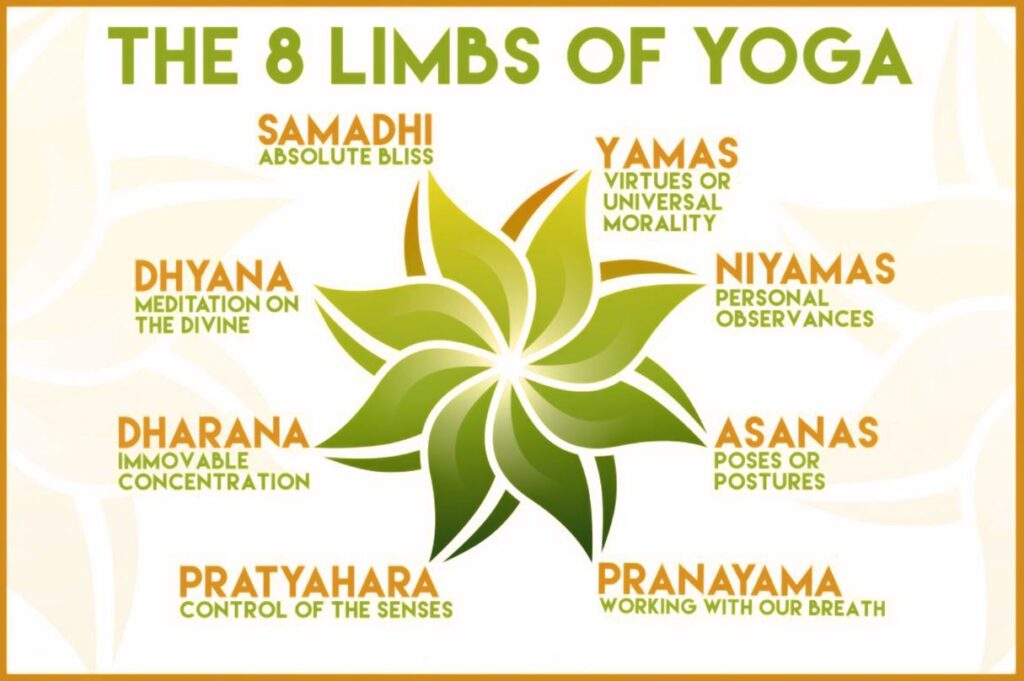
I have not reinvented the wheel. I am basically using Pantanjali’s 8 limbs with an interpretation twist. I have the ‘Zimboga 7-step Process to Freedom‘.
Goal
The goal of the process is to achieve happiness through freedom. Freedom from physical suffering, freedom from mental suffering and freedom from spiritual suffering. In this process we can gain some control over our minds, bodies and spirits.
This is not some invasive religion to challenge your Christianity. There are no demons or gods. It is just a lifestyle or life hack process. Yoga is a set of tools and skills which lead to health, wellness and happiness. Yoga originated in Asia so it naturally seems odd to us in the West, but being from another culture does not make it evil. Further, Yoga often uses an ancient Indian language (Sanskrit) which should only frighten the small minded (I don’t use much Sanskrit as it seems unnecessarily elitist. My yoga is already challenging enough without forcing people to learn a new language). Consider for just a moment that our American, Western culture does not have all the answers. Evidence suggests that this is the case. There are so many unhealthy, unhappy people (even sitting in church pews).
Yoga does partner well with religions as it makes it easier to connect with the divine but it’s not a religion itself. The fact that many Christians, Buddhists, Hindus, Sikhs, Jainists, and Muslims use yoga and the Eastern religions may have evolved alongside yoga does not mean yoga is a religion itself. In the Indian sub-continent, yoga has been part of the culture so long that when religions began and grew they did so integrating with yogic principles and wisdom. There are, however, many yoga studios, ashrams and yoga traditions that do adopt a version of yoga with one of the Eastern religions that evolved with yoga. For example, in the Knoxville area there is a Kundalini community that is integrated with Sikh religious practices. They wear Sikh clothing and sing Sikh songs that reference religious figures. Kundalini is a great yoga tradition with valuable aspects but, for me, the local version is too religious. Again, to conclude, just because some people integrate a religion with the yoga lifestyle does not mean yoga is a religion.
The 7 Steps
Step 1 – Things you should do with respect to others. These kinda reflect cultural rules, like don’t steal from your neighbor and don’t kill him either. Sound familiar?
Step 2 – Things you should do with respect to yourself. These kinda reflect what you learned as a child, like take a shower and learn useful things. I also appreciate those who shower.
Step 3 – Realize your body is an amazing machine. Get it in good working order. Remember; no core, no yoga…
Step 4 – Now we start getting more esoteric. Realize that there is subtle energy out there and learn to use and move it with the breath. Just because you can’t see it or measure it yet, doesn’t mean its not there.
Step 5 – Learn to focus inwards by ignoring outside distractions. This step teaches us awareness and sets us up for the next step.
Step 6 – Learn to focus the mind on what we choose rather than it running off on tangents. Useful I think.
Step 7 – Using the other limbs to meditate. The goal is effortless awareness and consciousness.
Step 8 – More study is required for this one as it’s quite esoteric. To achieve it you’ll need to know what it is your working towards.
Note on Step 9 (Samadhi)
Believing you are your individual body and mind causes you to feel separated and isolated from all else (it causes you to even feel separate from the divine, and many people want to feel closer to the divine). Your true self is eternal and spiritual, your body and mind will eventually die. This is belief of isolation is the source of suffering.
In short, Samadhi is transcendence from the sense of individuality to oneness with the universe. That is, figuring out your true, beautiful, eternal self. Peace, happiness and freedom is achieved and available on demand.
So, quick and easy to say. Not so quick and easy to do. Come to class, we’d better get started…