Zimboga Style Characteristics
First a little of how my background has influenced my yoga teaching.
My whole life I’ve been a leader and athlete. In school, in Boy Scouts and in the Army I’ve naturally taken control of groups. I always shown a capacity to build teams and mentor individuals. I played sports and competed in various physical activities all my life. Still now I am involved in many activities such as whitewater kayaking, rock climbing, skiing and snowboarding, backpacking, mountain biking, acro-yoga, and a few others. I was even a personal trainer for a few years doing group fitness boot camps with a strong individualized emphasis on form and abilities. All this factors into how I teach: – the team building, the personal training, the mentoring, the penchant to push boundaries.
I began my yoga journey doing ‘Power Yoga’. Due to my combat injuries, I needed to build strength and blow off steam. For the longest time I sought out Vinyasa, Power, Baptiste and Astanga for their strenuous and challenging flows. Over time I did begin to value the other forms and styles, and when I began teaching I was primarily a Power instructor, but found that I also had a knack for Yin and Restorative.
So Zimboga is heavily influenced by Iyengar Yoga for it’s attention to form and use of props, Power Yoga for its attention to cardio and strength, Sculpt and Tone Yoga for it’s focus on specific muscles much like Barre and Pilates.
You may find one or two of these things in other yoga classes. It’s the combination of all these things that makes Zimboga different:
- the 5-phase, 75 minute class
- the circle arrangement of mats
- the inclusion of a workshop every class
- the wide variety of class types (dance, yin, power, slow flow, restorative, partner etc)
- the integration of elements of Barre and Pilates when necessary to address a class need
- the integration of mobility drills into the ‘common core class mini-flows’
- the inclusion of all 8-limbs and 6 branches of yoga
- the integration of our class and our community
- the focus on advanced yoga vs beginner yoga
- the hands-on adjustments
- the focus on form
- the focus on individuals within the class – personal attention to your specific needs as much as possible
- the detailed and constant explanation of why I am calling a pose, movement or correction
- the use of drums, singing bowls, my singing, or sound healing
- the regular use of pranayama & meditation
- the regular use of props, especially the yoga wheel
- a genuine effort to yoke mind, body and spirit while staying true to a gym workout
- running a class that is suitable for all levels of students while still challenging advanced yogis
- enhancing the power of class with tips, techniques, demonstrations and additional practice on Facebook
- posting my flows and ideas so that students can access them outside of class
Fitness vs. Other Yogic Tenants
Most people coming to class are interested in getting into shape, losing weight or staying in shape. For this reason there is a heavy emphasis on exercise. Most of the classes involve strength, cardio, balance and core work.
Many yoga instructors sneer at doing pulses, Barre drills, Pilates exercises or repetitions in a yoga class. Because the bulk of those in class want to get into shape I see no reason not to use an ‘all of the above’ approach. Yoga is about ‘yoking mind, bod & spirit’. Part of gaining control of your body is getting into shape so why not use all the tools available to do that? There is a way to selectively add ‘non-traditional’ yoga exercise to a class and have the class still be unmistakably a yoga class.
While ‘Asanas’ (physical postures) are what we spend the bulk of out time on, I do introduce the other limbs of yoga such as ethical behavior, meditation, breathing, inner awareness, focus and reaching out to greater power. Yoga itself is not a religion. You can use yoga to enhance a religious practice if you choose that but there is no need to make yoga about religion. I don’t. Being open to connecting with life, joy, health and positive energy is different than religion.
I make an effort to put up posters on the wall in class. Please take a moment to look at them each class so you slowly become familiar with a little yogic philosophy. Also, some of posters have Asanas on them. If you use the chair, you can move them from the storage room to the hooks in the M/B room. This way you can practice when the room is not being used for classes. They are somewhat fragile so please be gentle with them.
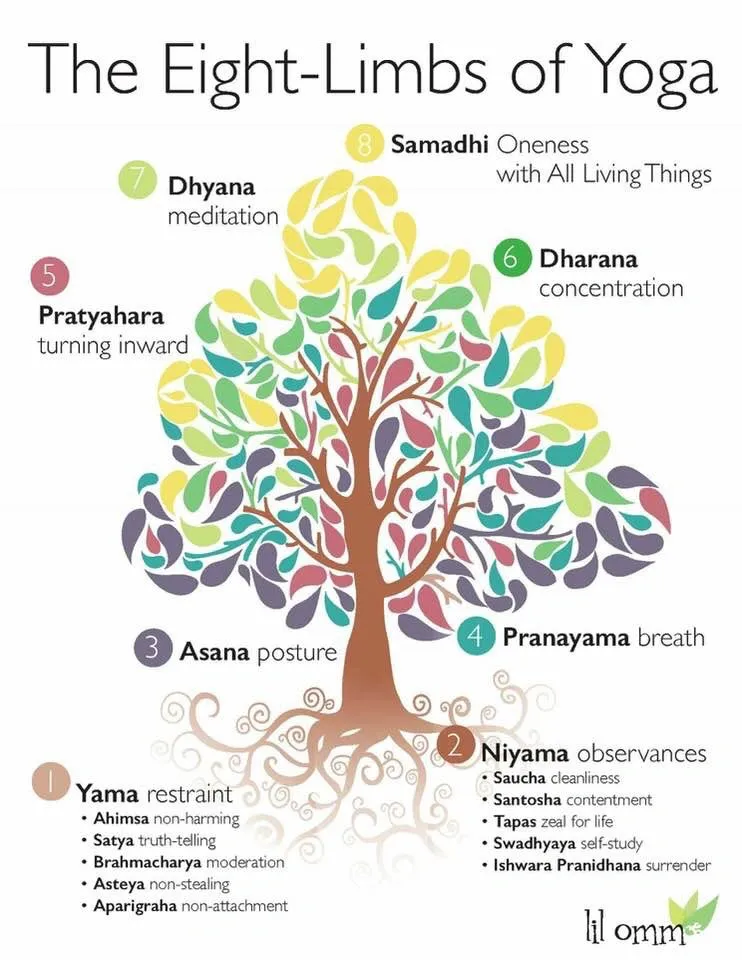
Organizations like AA use a 12-step program to walk you away from substance abuse to a healthier lifestyle. In Zimboga I’ve interpreted the 8 limbs of Yoga into a 7-step program towards freedom. Freedom from physical suffering, freedom from mental suffering and freedom from spiritual suffering. Follow this link to read a short, 50 000ft view description of the process.
Advanced-Focus Classes
It seems to me, for the purpose of maximizing business profits, all the yoga studios in our area always have beginner classes. Members go for years, even decades and never progress beyond the 30 most common postures. Even then, their form is not what it should be after spending so much time and money doing yoga.
Zimboga always is an advanced class that is suitable for beginners. In this way there is always room for yogis to grow and improve their practice, even if they are already advanced. Pulling off advanced classes in a room of people varying from 1st time on the mat to crazy impressive is my specialty.
Come try it out, expect to be challenged, expect to grow, expect to belong.